
Online Database of Chemicals from Around the World
| INA Pharmaceuticals Pvt. Ltd. | India | |||
|---|---|---|---|---|
 | inapharma.in | |||
 | +91 7815933367 | |||
 | rd@inapharma.in | |||
| Chemical manufacturer since 2018 | ||||
| chemBlink Standard supplier since 2026 | ||||
| Classification | Pharmaceutical intermediate >> Heterocyclic compound intermediate >> Pyrazines |
|---|---|
| Name | 3-Methoxy-5-methyl-2-pyrazinamine |
| Molecular Structure | 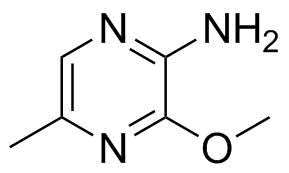 |
| Molecular Formula | C6H9N3O |
| Molecular Weight | 139.16 |
| CAS Registry Number | 89464-87-9 |
| EC Number | 643-017-4 |
| SMILES | CC1=CN=C(C(=N1)OC)N |
| Density | 1.2±0.1 g/cm3 Calc.* |
|---|---|
| Boiling point | 249.6±35.0 °C 760 mmHg (Calc.)* |
| Flash point | 104.8±25.9 °C (Calc.)* |
| Index of refraction | 1.558 (Calc.)* |
| * | Calculated using Advanced Chemistry Development (ACD/Labs) Software. |
| Hazard Symbols |   GHS05;GHS07 Danger Details GHS05;GHS07 Danger Details | ||||||||||||
|---|---|---|---|---|---|---|---|---|---|---|---|---|---|
| Risk Statements | H317-H318 Details | ||||||||||||
| Safety Statements | P261-P264+P265-P272-P280-P302+P352-P305+P354+P338-P317-P321-P333+P317-P362+P364-P501 Details | ||||||||||||
| Hazard Classification | |||||||||||||
| |||||||||||||
| SDS | Available | ||||||||||||
 chemBlink Chemical Story
|
3-Methoxy-5-methyl-2-pyrazinamine, CAS 89464-87-9, is a small nitrogen-containing heteroaromatic compound used mainly as a research and synthetic intermediate. It is also known as 2-amino-3-methoxy-5-methylpyrazine or 3-methoxy-5-methylpyrazin-2-amine. Its molecular formula is C6H9N3O and its molecular weight is 139.16. The molecule contains a pyrazine ring bearing an amino group, a methoxy group, and a methyl group, a compact arrangement that has made it useful as a building block in medicinal chemistry research. Pyrazine is a six-membered aromatic heterocycle containing two nitrogen atoms opposite one another in the ring. Although it resembles benzene geometrically, replacing two carbon atoms with nitrogen substantially changes the electronic properties of the ring. Pyrazine derivatives occur widely in medicinal chemistry because the ring nitrogens can influence polarity, hydrogen-bonding interactions, basicity, and the way a molecule fits into a biological binding site. CAS 89464-87-9 adds three different substituents to this heterocyclic framework. The amino group provides both a potential hydrogen-bonding site and a useful point for forming new chemical bonds. The methoxy group modifies the electronic and steric environment of the ring, while the methyl group supplies a small hydrophobic substituent. For a medicinal chemist, such a molecule is not simply a substituted pyrazine; it is a ready-made fragment whose properties can be incorporated into a larger molecular design. A particularly informative chapter in the history of this compound comes from research on endothelin receptors. Endothelin-1 is a powerful endogenous signaling peptide with pronounced effects on blood vessels. Among its receptors, the endothelin-A (ETA) receptor became an important target for researchers seeking non-peptide molecules capable of blocking endothelin-mediated responses. In 1997, Bradbury and coworkers at Zeneca Pharmaceuticals reported a systematic medicinal chemistry study of non-peptide ETA receptor antagonists based on naphthalenesulfonamides. The researchers investigated several six-membered nitrogen heterocycles as replacements for an isoxazole-containing portion of an earlier antagonist. Pyridine, pyrimidine, pyridazine, and pyrazine derivatives were explored, and the study found that 2-pyrazines provided particularly useful opportunities for improving receptor affinity. 3-Methoxy-5-methyl-2-pyrazinamine appears in the synthetic chemistry associated with this research program. Its amino group allows the pyrazine fragment to be connected to a sulfonyl-containing molecular framework, producing N-pyrazinyl sulfonamides that could then be evaluated for ETA receptor activity. The compound itself should not be described as an endothelin antagonist; rather, it served as one of the heterocyclic building blocks from which researchers constructed and compared biologically active derivatives. This distinction is important because medicinal chemistry often advances through structure-activity relationship studies, usually abbreviated SAR. Instead of discovering a single molecule and stopping there, researchers prepare a family of related compounds and systematically change one structural feature at a time. They may replace one heterocycle with another, move a substituent to a different position, or exchange a methyl group for chlorine or another small group. Biological testing then reveals how each structural change affects potency and selectivity. The 1997 study provides an excellent example. Optimization of substituents around the pyrazine ring ultimately produced highly potent and selective ETA receptor antagonists. One reported 5-chloro-3-methoxy-2-pyrazinyl compound reached an ETA pIC50 value of 8.1 and showed prolonged inhibition of an endothelin-induced pressor response in rats. These results belonged to the more elaborate sulfonamide derivatives, not to CAS 89464-87-9 itself, but they demonstrate why substituted aminopyrazines were useful components of the research program. The compound is also interesting from a preparative standpoint. Published patent chemistry describes several routes to 3-methoxy-5-methylpyrazin-2-amine. In one approach, 2-amino-3-bromo-5-methylpyrazine reacts with sodium methoxide in methanol, replacing bromine with methoxy functionality. Another patented process starts from the corresponding pyrazine N-oxide and uses catalytic hydrogenation to give 3-methoxy-5-methylpyrazin-2-amine in high reported yield. These alternative routes illustrate how heteroaromatic building blocks can be prepared by manipulating substituents on an already assembled ring. Today, CAS 89464-87-9 is commercially offered primarily as a research building block. Its story is therefore not that of a famous medicine or bulk industrial chemical. Instead, it represents the experimental vocabulary of medicinal chemistry. Researchers need collections of small, well-defined heterocycles so that molecular structures can be varied systematically and the consequences measured. 3-Methoxy-5-methyl-2-pyrazinamine illustrates how much information can be hidden inside a seemingly obscure catalog chemical. Three substituents on a six-membered nitrogen ring gave medicinal chemists one particular combination of electronic properties, geometry, and synthetic reactivity to test. It may never become a medicine itself, but molecules like it make possible one of the fundamental processes of drug discovery: change the structure, measure the result, learn from the difference, and design the next molecule. References 1. Bradbury, R. H.; Bath, C.; Butlin, R. J.; Dennis, M.; Heys, C.; Hunt, S. J.; James, R.; Mortlock, A. A.; Sumner, N. F.; Tang, E. K.; Telford, B.; Whiting, E.; Wilson, C. (1997). "New Non-Peptide Endothelin-A Receptor Antagonists: Synthesis, Biological Properties, and Structure-Activity Relationships of 5-(Dimethylamino)-N-pyridyl-, -N-pyrimidinyl-, -N-pyridazinyl-, and -N-pyrazinyl-1-naphthalenesulfonamides." Journal of Medicinal Chemistry, 40, 996-1004. https://doi.org/10.1021/jm9604585 2. U.S. Patent US5668137A (1997). Synthetic chemistry relating to substituted aminopyrazines and endothelin receptor antagonists. https://patents.google.com/patent/US5668137A/en 3. U.S. Patent US5998618A (1999). Process for preparing 3-alkoxy-5-alkylpyrazin-2-amines. https://patents.google.com/patent/US5998618A/en |
| Market Analysis Reports |