
Online Database of Chemicals from Around the World
| Hangzhou Leap Chem Co., Ltd. | China | |||
|---|---|---|---|---|
 | www.leapchem.com | |||
 | +86 (571) 8771-1850 | |||
 | market19@leapchem.com | |||
 | QQ Chat | |||
| Chemical manufacturer since 2006 | ||||
| chemBlink Standard supplier since 2015 | ||||
| Shanghai Fuxin Pharmaceutical Co., Ltd. | China | |||
|---|---|---|---|---|
| www.fuxinpharm.com | |||
| +86 (21) 3130-0828 +86 18645121291 | |||
 | +86 (21) 3130-0828 | |||
| contact@fuxinpharm.com | |||
| Chemical manufacturer since 2016 | ||||
| chemBlink Standard supplier since 2018 | ||||
| Changzhou Jiuwu Chemical Co., Ltd. | China | |||
|---|---|---|---|---|
| www.jiuwuchem.com | |||
| +86 (519) 8512-1086 +86 13775162768 | |||
| +86 (519) 8512-5369 | |||
| info@jiuwuchem.cn | |||
| QQ Chat | |||
| Chemical manufacturer since 2009 | ||||
| chemBlink Standard supplier since 2023 | ||||
| Classification | Flavors and spices >> Synthetic spice >> Carboxylic acid and ester perfume >> Aliphatic carboxylate |
|---|---|
| Name | 3-Hydroxypropanoic acid methyl ester |
| Synonyms | Methyl 3-hydroxypropionate; Methyl hydracrylate; Methyl beta-hydroxypropionate; beta-Hydroxypropionic acid methyl ester |
| Molecular Structure | 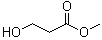 |
| Molecular Formula | C4H8O3 |
| Molecular Weight | 104.10 |
| CAS Registry Number | 6149-41-3 |
| EC Number | 817-682-8 |
| SMILES | COC(=O)CCO |
| Solubility | Freely soluble (477 g/L) (25 °C), Calc.* |
|---|---|
| Density | 1.1160 g/cm3 (20 °C)** |
| Melting point | 147-148 °C (benzene cyclohexane )*** |
| Boiling point | 179 °C**** |
| Refractive index | 1.4228 (589.3 nm 20 °C)** |
| Flash point | 72.6±12.6 °C, Calc.* |
| * | Calculated using Advanced Chemistry Development (ACD/Labs) Software V11.02 (©1994-2016 ACD/Labs) |
| ** | Fein, M. L. |
| *** | Butenandt, Adolf |
| **** | "PhysProp" data were obtained from Syracuse Research Corporation of Syracuse, New York (US) |
| Hazard Symbols |  GHS07 Warning Details GHS07 Warning Details | ||||||||||||||||||||
|---|---|---|---|---|---|---|---|---|---|---|---|---|---|---|---|---|---|---|---|---|---|
| Risk Statements | H302-H315-H319-H335 Details | ||||||||||||||||||||
| Safety Statements | P261-P264-P264+P265-P270-P271-P280-P301+P317-P302+P352-P304+P340-P305+P351+P338-P319-P321-P330-P332+P317-P337+P317-P362+P364-P403+P233-P405-P501 Details | ||||||||||||||||||||
| Hazard Classification | |||||||||||||||||||||
| |||||||||||||||||||||
| SDS | Available | ||||||||||||||||||||
 chemBlink Chemical Story
|
3-Hydroxypropanoic acid methyl ester, commonly known as methyl 3-hydroxypropionate, is a hydroxy ester consisting of a three-carbon chain bearing a terminal methyl ester group and a primary hydroxyl group. It is an important intermediate in organic synthesis and serves as a versatile building block for the preparation of polymers, pharmaceuticals, fine chemicals, and specialty materials. Structurally, the molecule contains two key functional groups: a methyl ester (–COOCH₃) and a primary alcohol (–CH₂OH). These groups are located at opposite ends of a three-carbon backbone, giving the molecule bifunctional reactivity. The ester group is susceptible to hydrolysis, transesterification, and nucleophilic acyl substitution reactions, while the hydroxyl group can undergo oxidation, esterification, etherification, and other alcohol transformations. The compound may be viewed as the methyl ester derivative of 3-hydroxypropionic acid, a naturally occurring hydroxy acid that has attracted significant interest as a potential platform chemical in renewable and biobased chemistry. Esterification with methanol increases volatility and often improves handling characteristics compared with the corresponding free acid. From an electronic perspective, the ester carbonyl is the most electrophilic site in the molecule. The carbonyl carbon is activated toward nucleophilic attack by the adjacent oxygen atom, which stabilizes reaction intermediates through resonance effects. In contrast, the hydroxyl group acts primarily as a nucleophilic and hydrogen-bonding site. The presence of both an ester and an alcohol functionality makes methyl 3-hydroxypropionate a useful synthetic intermediate. It can participate in intramolecular or intermolecular reactions leading to cyclic esters, polyesters, and other oxygen-containing compounds. The molecule is frequently employed in the synthesis of specialty monomers and functionalized intermediates. Physically, methyl 3-hydroxypropionate is a polar organic compound. The hydroxyl group contributes significant hydrogen-bonding capability, while the ester functionality adds dipolar character. As a result, the compound exhibits moderate solubility in water and good solubility in many polar organic solvents such as alcohols, ketones, and esters. Hydrogen bonding strongly influences its physical properties. The hydroxyl group can act as both a hydrogen-bond donor and acceptor, leading to intermolecular association in the liquid phase. This interaction affects boiling point, viscosity, and solvent compatibility. Chemically, the primary alcohol can be oxidized to yield aldehyde or carboxylic acid derivatives. Hydrolysis of the methyl ester generates 3-hydroxypropionic acid, while transesterification can produce alternative ester derivatives. These reactions make the compound a valuable precursor in multi-step synthetic sequences. In polymer and materials chemistry, compounds related to 3-hydroxypropionic acid are considered attractive renewable feedstocks because they can be transformed into acrylic acid derivatives, biodegradable polymers, and other industrially important chemicals. Methyl 3-hydroxypropionate often serves as a convenient intermediate in such transformations. From a biosynthetic perspective, 3-hydroxypropionic acid and its derivatives have been investigated as potential products of engineered microbial fermentation processes. Interest in these compounds stems from their potential role in sustainable chemical manufacturing and the development of bio-based alternatives to petrochemical feedstocks. Overall, 3-hydroxypropanoic acid methyl ester is a bifunctional hydroxy ester characterized by the presence of both a primary alcohol and a methyl ester group. Its significance lies in its versatility as a synthetic intermediate, its role in polymer and materials chemistry, and its importance as a derivative of the emerging platform chemical 3-hydroxypropionic acid. References 2021. Influence of calcination temperature on the cooperative catalysis of base sites and gold nanoparticles on hydrotalcite-supported gold materials for the base-free oxidative esterification of 1, 3-propanediol with methanol to methyl 3-hydroxypropionate. Reaction Kinetics, Mechanisms and Catalysis. DOI: 10.1007/s11144-021-02042-4 |
| Market Analysis Reports |