
Online Database of Chemicals from Around the World
| wuhan chemi Pharmacy Chemical Technology Co., Ltd. | China | |||
|---|---|---|---|---|
 | www.chemipharm.com.cn | |||
 | +86 13971619949 | |||
 | gmn424@chemipharm.com.cn | |||
 | QQ Chat | |||
 | WeChat: 13971619949 | |||
| Chemical manufacturer since 2014 | ||||
| chemBlink Standard supplier since 2026 | ||||
| Classification | Pharmaceutical intermediate >> Heterocyclic compound intermediate >> Pyrazines |
|---|---|
| Name | 5,6-Diamino-2,3-dicyanopyrazine |
| Molecular Structure | 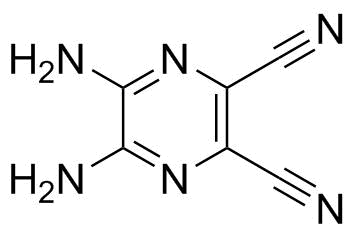 |
| Molecular Formula | C6H4N6 |
| Molecular Weight | 160.14 |
| CAS Registry Number | 36023-58-2 |
| EC Number | 679-795-7 |
| SMILES | C(#N)C1=C(N=C(C(=N1)N)N)C#N |
| Density | 1.6±0.1 g/cm3 Calc.* |
|---|---|
| Melting point | 332 °C (Expl.) |
| Boiling point | 625.6±55.0 °C 760 mmHg (Calc.)* |
| Flash point | 332.2±31.5 °C (Calc.)* |
| Index of refraction | 1.678 (Calc.)* |
| * | Calculated using Advanced Chemistry Development (ACD/Labs) Software. |
| Hazard Symbols |   GHS06;GHS07 Danger Details GHS06;GHS07 Danger Details | ||||||||||||||||||||||||
|---|---|---|---|---|---|---|---|---|---|---|---|---|---|---|---|---|---|---|---|---|---|---|---|---|---|
| Risk Statements | H301-H302+H312+H332-H302-H311-H312-H315-H319-H331-H332-H335 Details | ||||||||||||||||||||||||
| Safety Statements | P261-P262-P264-P264+P265-P270-P271-P280-P301+P316-P301+P317-P302+P352-P304+P340-P305+P351+P338-P316-P317-P319-P321-P330-P332+P317-P337+P317-P361+P364-P362+P364-P403+P233-P405-P501 Details | ||||||||||||||||||||||||
| Hazard Classification | |||||||||||||||||||||||||
| |||||||||||||||||||||||||
| SDS | Available | ||||||||||||||||||||||||
 chemBlink Chemical Story
|
5,6-Diamino-2,3-dicyanopyrazine is a nitrogen-rich heteroaromatic compound derived from the pyrazine ring system, in which amino groups are present at the 5- and 6-positions and nitrile substituents are located at the 2- and 3-positions. The pyrazine core is an electron-deficient six-membered aromatic heterocycle containing two nitrogen atoms at opposite positions, and substitution with both electron-donating amino groups and strongly electron-withdrawing cyano groups creates a highly polarized molecular framework. Compounds of this structural type are generally studied within the field of heterocyclic and functional materials chemistry. The development of highly substituted pyrazines gained attention during the twentieth century as synthetic methods for nitrile- and amine-functionalized aromatics became more accessible. The ability to introduce multiple electron-withdrawing and electron-donating groups onto a single heteroaromatic ring allowed chemists to tune electronic properties for applications in dyes, organic electronic materials, and advanced intermediates. The synthesis of 2,3-dicyanopyrazine derivatives typically involves cyclization and functional group transformation strategies starting from smaller nitrogen-containing precursors. Introduction of nitrile groups onto heterocycles is commonly achieved through oxidative or substitution-based cyanation methods, while amino substituents may be introduced via nucleophilic substitution of activated halopyrazine intermediates. In molecules such as 5,6-diamino-2,3-dicyanopyrazine, the arrangement of substituents reflects stepwise functionalization of a preformed pyrazine scaffold. The presence of two amino groups on the pyrazine ring increases electron density and introduces hydrogen-bond donor capability. These amino groups can participate in intermolecular hydrogen bonding, influencing solid-state packing and aggregation behavior. At the same time, the two nitrile groups are strongly electron-withdrawing and contribute to lowering the electron density of the aromatic system, increasing its electrophilic character and altering its redox properties. This combination of electron-donating and electron-withdrawing substituents makes the compound electronically asymmetric and highly polarized. Such systems are of interest in the study of donor–acceptor heteroaromatic molecules, which are widely investigated for their optical and electronic properties. In particular, cyano-substituted nitrogen heterocycles can exhibit strong dipole moments and charge-transfer characteristics, which are relevant in the design of functional organic materials. Pyrazine derivatives bearing amino and cyano substituents have been explored as intermediates in the synthesis of more complex heterocyclic systems. The reactive amino groups can undergo acylation, alkylation, or condensation reactions, while the nitrile groups can be transformed into amides, carboxylic acids, or heterocyclic rings through cyclization reactions. This multifunctionality makes such compounds valuable building blocks in synthetic organic chemistry. From a materials chemistry perspective, highly substituted pyrazines are of interest due to their rigid aromatic structure and tunable electronic properties. The presence of multiple nitrogen atoms in the ring system enhances coordination ability toward metal ions, suggesting potential relevance in coordination chemistry and the formation of metal–organic assemblies. The combination of donor and acceptor groups within the same molecule may also influence stacking interactions in the solid state. Spectroscopic characterization of compounds such as 5,6-diamino-2,3-dicyanopyrazine typically involves techniques including nuclear magnetic resonance spectroscopy, infrared spectroscopy, and mass spectrometry. The nitrile groups produce characteristic stretching vibrations in infrared spectra, while amino protons and aromatic signals provide structural information in nuclear magnetic resonance analysis. These methods are standard tools for confirming substitution patterns in heteroaromatic compounds. Overall, 5,6-diamino-2,3-dicyanopyrazine is a highly functionalized pyrazine derivative that combines electron-donating amino groups and electron-withdrawing nitrile groups on a nitrogen-rich aromatic scaffold. Its significance lies in its role as a multifunctional heterocyclic intermediate and as a representative example of electronically polarized pyrazine systems used in synthetic and materials chemistry research. References 2023. Access to Imidazopyrazine Conjugated Benzamides as Potential Anticancer Agents. Russian Journal of General Chemistry. DOI: 10.1134/s1070363223100262 2015. Solvent-Free Functionalization of Carbon Nanomaterials. Green Processes for Nanotechnology. DOI: 10.1007/978-3-319-15461-9_6 2014. Synthesis and characterization of amphiphilic graphene. Science China Technological Sciences. DOI: 10.1007/s11431-014-5454-z |
| Market Analysis Reports |