
Online Database of Chemicals from Around the World
| Pure Bio Medical Jiangsu Ltd. | China | |||
|---|---|---|---|---|
 | www.purejs.cn | |||
 | +86 (025) 8560-7383 | |||
 | jiangziwei@purejs.cn | |||
| Chemical manufacturer since 2019 | ||||
| chemBlink Standard supplier since 2026 | ||||
| Classification | Biochemical >> Inhibitor >> G protein coupled receptor(GPCR & G Protein) >> CaSR activator |
|---|---|
| Name | Evocalcet |
| Synonyms | 2-[4-[(3S)-3-[[(1R)-1-naphthalen-1-ylethyl]amino]pyrrolidin-1-yl]phenyl]acetic acid; 4-((3S)-3-(((1R)-1-(1-Naphthalenyl)ethyl)amino)-1-pyrrolidinyl)benzeneacetic acid |
| Molecular Structure | 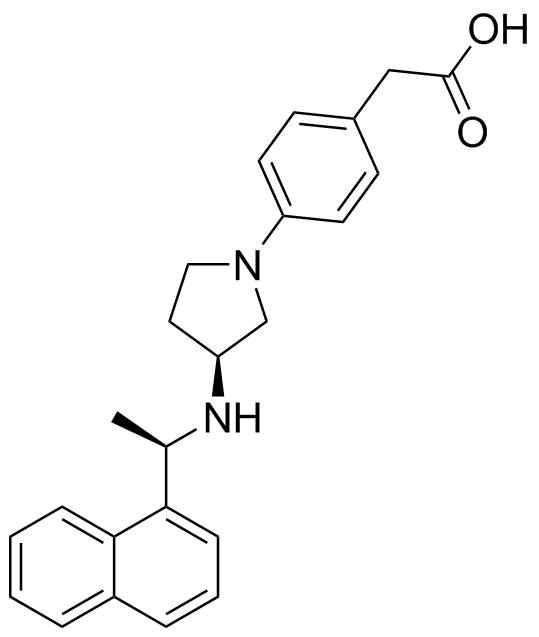 |
| Molecular Formula | C24H26N2O2 |
| Molecular Weight | 374.48 |
| CAS Registry Number | 870964-67-3 |
| EC Number | 887-622-3 |
| SMILES | C[C@H](C1=CC=CC2=CC=CC=C21)N[C@H]3CCN(C3)C4=CC=C(C=C4)CC(=O)O |
| Density | 1.2±0.1 g/cm3 Calc.* |
|---|---|
| Boiling point | 594.4±50.0 °C 760 mmHg (Calc.)* |
| Flash point | 313.3±30.1 °C (Calc.)* |
| Index of refraction | 1.666 (Calc.)* |
| * | Calculated using Advanced Chemistry Development (ACD/Labs) Software. |
| Hazard Symbols |  GHS07 Warning Details GHS07 Warning Details | ||||||||||||
|---|---|---|---|---|---|---|---|---|---|---|---|---|---|
| Risk Statements | H302-H315-H319 Details | ||||||||||||
| Safety Statements | P501-P270-P264-P280-P302+P352-P337+P313-P305+P351+P338-P362+P364-P332+P313-P301+P312+P330 Details | ||||||||||||
| Hazard Classification | |||||||||||||
| |||||||||||||
| SDS | Available | ||||||||||||
 chemBlink Chemical Story
|
Evocalcet is a small-molecule pharmaceutical compound developed as a calcimimetic agent, meaning it mimics the action of extracellular calcium at the calcium-sensing receptor (CaSR). It was designed for the treatment of secondary hyperparathyroidism, a condition commonly associated with chronic kidney disease in which parathyroid hormone (PTH) levels become abnormally elevated due to disrupted calcium and phosphate homeostasis. The development of evocalcet arose from efforts to improve upon earlier calcimimetics such as cinacalcet. While cinacalcet demonstrated clinical efficacy, it was often associated with gastrointestinal side effects that limited tolerability in some patients. Medicinal chemistry programs therefore focused on identifying structurally distinct CaSR agonists with improved pharmacokinetic and safety profiles. Evocalcet emerged from these efforts as a second-generation calcimimetic with enhanced receptor activity and reduced off-target effects. Structurally, evocalcet contains a rigid bicyclic amine framework linked to aromatic and heterocyclic substituents that contribute to its binding affinity for the calcium-sensing receptor. The molecule is designed to interact allosterically with CaSR, enhancing the receptor’s sensitivity to extracellular calcium ions. This leads to suppression of parathyroid hormone secretion from the parathyroid gland. The reduction in PTH levels helps regulate calcium and phosphate metabolism, which is often disrupted in patients with renal impairment. The calcium-sensing receptor is a G protein–coupled receptor expressed primarily in the parathyroid gland and kidneys. It plays a central role in maintaining systemic calcium balance. When activated, it inhibits PTH secretion, reducing calcium mobilization from bone and decreasing renal calcium reabsorption. Evocalcet functions as a positive allosteric modulator of this receptor, amplifying its response to physiological calcium levels. Evocalcet was developed through structure–activity relationship studies aimed at optimizing potency, selectivity, and oral bioavailability. Modifications of amine-containing scaffolds and hydrophobic aromatic regions were explored to achieve strong receptor binding while minimizing gastrointestinal exposure-related adverse effects. The resulting compound exhibits high affinity for CaSR and improved pharmacological characteristics compared to earlier agents in its class. Clinically, evocalcet is used for the management of secondary hyperparathyroidism in patients undergoing hemodialysis. By reducing elevated PTH levels, it helps mitigate complications such as bone mineral disorders and vascular calcification, which are common in chronic kidney disease. Its oral administration and improved tolerability profile make it a useful therapeutic option in long-term disease management. The pharmacokinetics of evocalcet have been optimized to allow effective systemic exposure with reduced accumulation. It is metabolized primarily in the liver, and its dosing regimen is adjusted based on patient response and biochemical markers such as PTH, calcium, and phosphate levels. The therapeutic goal is to maintain these parameters within target ranges to reduce long-term complications. Overall, evocalcet represents an advancement in calcimimetic drug development, built on the understanding of calcium-sensing receptor biology and the need for improved therapies in chronic kidney disease–associated mineral disorders. Its mechanism of action as a CaSR allosteric activator, combined with improved tolerability compared to earlier agents, has made it an important option in the treatment of secondary hyperparathyroidism. References 2026. Evocalcet improved the PTH–calcium setpoint and suppressed parathyroid proliferation in mice model of primary hyperparathyroidism. Journal of Bone and Mineral Metabolism. DOI: 10.1007/s00774-026-01699-y 2026. Association of serum magnesium levels and calcimimetic use: fractures and cardiovascular events in Japanese haemodialysis patients. Journal of Bone and Mineral Metabolism. DOI: 10.1007/s00774-025-01682-z 2025. Spontaneous hemorrhage from a functionally well-controlled, non-enlarged but hyperplastic parathyroid gland due to secondary hyperparathyroidism: a case report. CEN Case Reports. DOI: 10.1007/s13730-025-01059-1 |
| Market Analysis Reports |