
Online Database of Chemicals from Around the World
| Shanghai Conson Industrial Co., Ltd. | China | |||
|---|---|---|---|---|
 | www.consonchem.com | |||
 | +86 (21) 6354-8358 | |||
 | +86 (21) 6353-6992 | |||
 | sales@consonchem.com | |||
| Chemical manufacturer | ||||
| chemBlink Standard supplier since 2006 | ||||
| Kingfirst Chemical (Nanjing) Co., Ltd. | China | |||
|---|---|---|---|---|
| www.kingfirstchem.com | |||
| +86 (25) 8452-2992 8477-3604 | |||
| +86 (25) 8452-1617 | |||
| marketing@kingfirstchem.com | |||
| Chemical manufacturer | ||||
| chemBlink Standard supplier since 2007 | ||||
| Shandong Haoyuan Group | China | |||
|---|---|---|---|---|
| www.haoyuangroup.cn | |||
| +86 (536) 519-9628 | |||
| +86 (536) 296-0566 | |||
| fenginfo@gmail.com | |||
| Chemical manufacturer | ||||
| chemBlink Standard supplier since 2008 | ||||
| Simagchem Corporation | China | |||
|---|---|---|---|---|
| www.simagchem.com | |||
| +86 13806087780 | |||
| +86 (592) 268-0237 | |||
| sale@simagchem.com | |||
| Chemical manufacturer since 2002 | ||||
| chemBlink Standard supplier since 2008 | ||||
| Hefei TNJ Chemical Industry Co., Ltd. | China | |||
|---|---|---|---|---|
| www.tnjchem.com | |||
| +86 (551) 6541-8684 | |||
| +86 (551) 6541-8697 | |||
| sales@tnjchem.com | |||
| Chemical manufacturer since 2001 | ||||
| chemBlink Standard supplier since 2010 | ||||
| Ring Specialty Chemicals Inc. | Canada | |||
|---|---|---|---|---|
| www.ringchemicals.com | |||
| +1 (416) 493-6870 | |||
| info@ringchemicals.com | |||
| Chemical distributor | ||||
| chemBlink Standard supplier since 2010 | ||||
| BOC Sciences | USA | |||
|---|---|---|---|---|
| www.bocsci.com | |||
| +1 (631) 485-4226 | |||
| +1 (631) 614-7828 | |||
| info@bocsci.com | |||
| Chemical manufacturer | ||||
| chemBlink Standard supplier since 2010 | ||||
| LEAPChem | China | |||
|---|---|---|---|---|
| www.leapchem.com | |||
| +86 (571) 8771-1850 | |||
| market19@leapchem.com | |||
 | QQ Chat | |||
| Chemical manufacturer since 2006 | ||||
| chemBlink Standard supplier since 2015 | ||||
| Ivy Fine Chemicals | USA | |||
|---|---|---|---|---|
| www.ivychem.com | |||
| +1 (856) 465-8550 | |||
| +1 (856) 616-1161 | |||
| sales@ivychem.com | |||
| Chemical manufacturer | ||||
| Indofine Chemical Company, Inc. | USA | |||
|---|---|---|---|---|
| www.indofinechemical.com | |||
| +1 (888) 463-6346 | |||
| +1 (908) 359-1179 | |||
| info@indofinechemical.com | |||
| Chemical manufacturer since 1981 | ||||
| Punjab Chemicals & Crop Protection Limited | India | |||
|---|---|---|---|---|
| www.punjabchemicals.com | |||
| +91 (22) 2674-7900 | |||
| +91 (22) 2673-6193 / 2673-6178 | |||
| pharmainfo@punjabchemicals.com | |||
| Chemical manufacturer since 1975 | ||||
| Frontier Scientific Services, Inc. | USA | |||
|---|---|---|---|---|
| www.frontierssi.com | |||
| +1 (302) 266-6891 (888) 577-2734 | |||
| +1 (302) 266-8296 | |||
| customerservice@frontierssi.com | |||
| Chemical manufacturer | ||||
| ECA International Corporation | USA | |||
|---|---|---|---|---|
| www.ecacorporation.com | |||
| +1 (847) 358-8178 | |||
| +1 (847) 358-8179 | |||
| order@ecacorporation.com | |||
| Chemical manufacturer | ||||
| Kingchem Inc. | USA | |||
|---|---|---|---|---|
| www.kingchem.com | |||
| +1 (800) 211-4330 (201) 825-9988 | |||
| +1 (201) 825-9148 | |||
| customer-service@kingchem.com | |||
| Chemical manufacturer since 1994 | ||||
| Sinbond Industrial Co., Ltd. | China | |||
|---|---|---|---|---|
| www.sinbondpharm.com | |||
| +86 (531) 8703-8285 +86 13583181986 +44 (208) 242-5518 | |||
| +86 (531) 8703-8285 | |||
| cici1124@gmail.com | |||
| QQ Chat | |||
| Chemical manufacturer since 2014 | ||||
| Classification | Chemical reagent >> Organic reagent >> Aromatic aldehyde (containing acetal, hemiacetal) |
|---|---|
| Name | 3,4,5-Trimethoxybenzaldehyde |
| Molecular Structure | 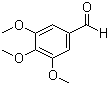 |
| Molecular Formula | C10H12O4 |
| Molecular Weight | 196.20 |
| CAS Registry Number | 86-81-7 |
| EC Number | 201-701-6 |
| SMILES | COC1=CC(=CC(=C1OC)OC)C=O |
| Density | 1.1±0.1 g/cm3 Calc.* |
|---|---|
| Melting point | 72 - 74 °C (Expl.) |
| Boiling point | 311.4±37.0 °C 760 mmHg (Calc.)*, 337.6 - 340.4 °C (Expl.) |
| Flash point | 136.8±26.5 °C (Calc.)* |
| Solubility | methanol: 0.1 g/mL (Expl.) |
| Index of refraction | 1.525 (Calc.)* |
| * | Calculated using Advanced Chemistry Development (ACD/Labs) Software. |
| Hazard Symbols |  GHS07 Warning Details | ||||||||||||||||||||||||
|---|---|---|---|---|---|---|---|---|---|---|---|---|---|---|---|---|---|---|---|---|---|---|---|---|---|
| Risk Statements | H302-H315-H319-H335 Details | ||||||||||||||||||||||||
| Safety Statements | P261-P264-P264+P265-P270-P271-P280-P301+P317-P302+P352-P304+P340-P305+P351+P338-P319-P321-P330-P332+P317-P337+P317-P362+P364-P403+P233-P405-P501 Details | ||||||||||||||||||||||||
| Hazard Classification | |||||||||||||||||||||||||
| |||||||||||||||||||||||||
| SDS | Available | ||||||||||||||||||||||||
 chemBlink Chemical Story
|
3,4,5-Trimethoxybenzaldehyde is an aromatic aldehyde that has become an important intermediate in natural product synthesis and medicinal chemistry. Although chemically simple, its significance lies in providing access to the 3,4,5-trimethoxyphenyl group, one of the most recognizable structural motifs in bioactive organic molecules. Rather than being valued as a commercial end product, it serves as a gateway to a broad family of compounds whose biological activities have influenced modern drug discovery. The origins of this chemistry can be traced to naturally occurring methoxylated aromatic compounds found in plants. Methoxy-substituted phenyl rings are common structural elements in lignin-derived molecules and numerous secondary metabolites. Their distinctive electronic properties and hydrophobic character attracted the attention of natural products chemists during the twentieth century, who recognized that subtle changes in methoxy substitution patterns could profoundly influence biological activity. Among these substitution patterns, the 3,4,5-trimethoxyphenyl group emerged as particularly important. It appears in a variety of natural products and inspired synthetic analogs with remarkable pharmacological properties. Studies of compounds such as combretastatins demonstrated that this aromatic motif contributes to highly specific interactions with biological targets, especially proteins involved in microtubule assembly. These discoveries established the 3,4,5-trimethoxyphenyl group as one of the classic pharmacophores in medicinal chemistry. 3,4,5-Trimethoxybenzaldehyde became the preferred synthetic starting material for introducing this pharmacophore because the aldehyde functionality can be transformed into numerous other functional groups. It readily participates in condensations, reductions, oxidations, cyclizations, and carbon-carbon bond-forming reactions, allowing chemists to prepare chalcones, stilbenes, heterocycles, alcohols, acids, oximes, and many other derivatives. Its versatility has made it a standard intermediate in both academic and industrial research laboratories. Beyond medicinal chemistry, the compound has also contributed to research in natural product synthesis, materials chemistry, and studies of structure-activity relationships. By providing a convenient route to systematic modification of the trimethoxyphenyl framework, it has enabled researchers to investigate how aromatic substitution patterns influence molecular recognition, biological potency, and physicochemical properties. The scientific importance of 3,4,5-trimethoxybenzaldehyde therefore extends well beyond its role as an aromatic aldehyde. It represents the entry point to one of the most influential aromatic pharmacophores in modern medicinal chemistry. Its continuing use illustrates how a simple synthetic intermediate can connect natural products chemistry with rational drug design, enabling generations of researchers to explore new bioactive molecules built upon a remarkably successful molecular framework. **References** 1. Pettit, G. R. et al. (1989). "Isolation and Structure of Combretastatins." *Canadian Journal of Chemistry*, 67, 1451-1457. 2. Cushman, M.; Nagarathnam, D. et al. (1991). Structure-activity studies of combretastatin analogs. *Journal of Medicinal Chemistry*. 3. Nicolaou, K. C.; Snyder, S. A. *Classics in Total Synthesis II*. Wiley, 2003. |
| Market Analysis Reports |