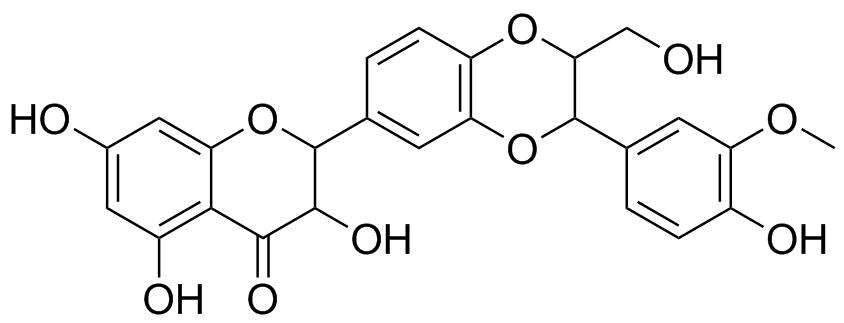
A botanical extract can have a registry number without having one molecular structure. Milk thistle extract, obtained from Silybum marianum, is a case in point. Its signature fraction is silymarin, a mixture rather than the name of a single pure substance. The fraction contains several related flavonolignans. Even the better-known term silibinin, or silybin, ordinarily refers to two closely related forms, silybin A and silybin B. This nested vocabulary explains why a label reporting the amount of extract cannot be read as a measurement of a particular flavonolignan.
Chemically, the flavonolignans bring together elements of flavonoid and lignan chemistry. Related components can differ in how fragments are connected or in their three-dimensional arrangements. Compounds with the same formula can therefore behave differently in a chromatographic separation. Analytical laboratories can use a pattern of peaks to characterize an extract and compare lots. To interpret such a fingerprint, it matters which peaks were identified, which were quantified, and whether a reported percentage refers to one component or to a group.
The plant was historically used for liver complaints. Modern investigations have turned this broad tradition into specific testable questions. The US National Toxicology Program characterized a milk thistle extract used in its animal feeding studies. The value of that characterization is not that the results automatically apply to any product with the same common name. It is that the composition and conditions of the experiment become easier to trace. An extract prepared from a different starting material or by a different process need not match the one used in the report.
A randomized trial published in 2012 illustrates a second kind of specificity. Fried and colleagues studied oral silymarin in people with chronic hepatitis C who had previously received interferon-based therapy without success. The trial did not find a significant advantage over placebo on its prespecified serum alanine aminotransferase outcome. That result concerns the preparation, population and endpoint studied. It neither establishes a benefit for other conditions nor rules out every biological effect of all components. The US National Center for Complementary and Integrative Health similarly concludes that the clinical evidence does not permit firm conclusions about effects on health conditions.
There is also a distinction between chemical quality and clinical benefit. A batch with a reproducible profile allows investigators to ask whether repeated experiments are testing similar material. The profile does not itself answer whether a patient benefits. Conversely, if a trial has a clinically relevant outcome, inadequate information about the extract can make it difficult to connect that result to another preparation. The two kinds of evidence support one another without being interchangeable. This is one reason reports that name the extract, describe its components and state the endpoint are more useful than a broad claim about the plant alone. They give future investigators enough information to judge what a replication would actually require.
The endpoint in the hepatitis C study also illustrates how a routine measurement fits into an experiment. Alanine aminotransferase is an enzyme measured in blood that can serve as a marker of liver injury. An enzyme reading is neither a count of virus particles nor a direct measurement of every way a patient might feel or function. The study defined in advance what change would qualify on the primary outcome. A precise account of a negative trial therefore keeps both the measured quantity and the threshold in view, rather than reducing the result to a verdict on the plant.
For researchers, the complexity is a reason to be more precise, not to set the extract aside. Biological observations can be linked to a characterized batch or to one isolated component. For readers, distinguishing the plant, its extract, the silymarin fraction and a single constituent is the first step in deciding whether two reports are actually talking about the same material.
References:
1. US National Toxicology Program. Milk thistle extract, Technical Report 565. https://ntp.niehs.nih.gov/sites/default/files/ntp/htdocs/lt_rpts/tr565.pdf
2. Fried MW et al. Effect of silymarin on liver disease in chronic hepatitis C: randomized controlled trial. JAMA. 2012;308:274–282. https://pubmed.ncbi.nlm.nih.gov/22797645/
3. NCCIH. Milk thistle: usefulness and safety. https://www.nccih.nih.gov/health/milk-thistle
|





 GHS08 Warning Details
 chemBlink Chemical Story