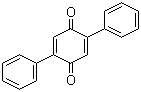
2,5-Diphenylquinone, CAS 844-51-9, is more precisely 2,5-diphenyl-1,4-benzoquinone, with molecular formula C18H12O2 and molecular weight about 260.3. PubChem records the compound as a benzoquinone ring bearing phenyl groups at the 2- and 5-positions. The central quinone retains two conjugated carbonyl groups, while the phenyl substituents extend the aromatic framework.
Quinones are important redox-active structures. A 1,4-benzoquinone can accept electrons and protons to form semiquinone or hydroquinone-related states, and substitution changes the reduction potential, color and chemical reactivity. Adding two phenyl groups increases conjugation and gives 2,5-diphenylquinone a useful scaffold for studying substituted quinone chemistry.
The molecule has also served as a synthetic intermediate. Published natural-product chemistry has used 2,5-diphenyl-1,4-benzoquinone as a precursor to naturally occurring terphenyl compounds and related quinones. The 2,5-diphenyl substitution pattern is already embedded in the target carbon skeleton, allowing later reactions to modify oxidation state and substituents without rebuilding the aromatic framework from the beginning.
Older biochemical work also examined substituted quinones in electron-transfer systems, reflecting the general ability of quinone carbonyls to participate in reversible redox chemistry. Such research uses should not be expanded into a claim that CAS 844-51-9 has a broad therapeutic or industrial function; public sources support it more clearly as a research reagent and synthetic building block.
Its chemical story therefore centers on a redox-active core decorated with two phenyl groups. The quinone ring supplies electron-accepting and transformation chemistry, while the phenyl groups enlarge the aromatic system and preassemble a terphenyl-like carbon framework. This makes the compound useful less as a bulk chemical than as a structurally informative intermediate in organic and natural-product chemistry.
References:
1. PubChem, 2,5-Diphenyl-1,4-benzoquinone, CID 70055, CAS 844-51-9.
2. Sawayama Y et al. Syntheses of Naturally Occurring Terphenyls and Related Compounds. Biosci Biotechnol Biochem. 2006;70:2998-3003.
3. Finley KT. The Chemistry of the Quinonoid Compounds. Wiley, 1974.
|






 GHS07;GHS08 Danger Details
 chemBlink Chemical Story