
Online Database of Chemicals from Around the World
| Simagchem Corporation | China | |||
|---|---|---|---|---|
 | www.simagchem.com | |||
 | +86 13806087780 | |||
 | +86 (592) 268-0237 | |||
 | sale@simagchem.com | |||
| Chemical manufacturer since 2002 | ||||
| chemBlink Standard supplier since 2008 | ||||
| Shanghai Rokem Industrial Co.Ltd. | China | |||
|---|---|---|---|---|
| www.rokem.com | |||
| +86 (21) 5081-1906 +86 18721069645 | |||
| +86 (21) 5881-8728 | |||
| milly@rokem.com | |||
| Chemical distributor since 2000 | ||||
| chemBlink Standard supplier since 2009 | ||||
| Hefei TNJ Chemical Industry Co., Ltd. | China | |||
|---|---|---|---|---|
| www.tnjchem.com | |||
| +86 (551) 6541-8684 | |||
| +86 (551) 6541-8697 | |||
| sales@tnjchem.com | |||
| Chemical manufacturer since 2001 | ||||
| chemBlink Standard supplier since 2010 | ||||
| Hangzhou Leap Chem Co., Ltd. | China | |||
|---|---|---|---|---|
| www.leapchem.com | |||
| +86 (571) 8771-1850 | |||
| market19@leapchem.com | |||
 | QQ Chat | |||
| Chemical manufacturer since 2006 | ||||
| chemBlink Standard supplier since 2015 | ||||
| Riverland Trading LLC. | USA | |||
|---|---|---|---|---|
| www.riverlandtrading.com | |||
| +1 (336).944-2293 | |||
| bens@riverlandtrading.com | |||
| Chemical distributor | ||||
| chemBlink Standard supplier since 2023 | ||||
| Mudanjiang Fengda Chemicals Import and Export Co., Ltd. | China | |||
|---|---|---|---|---|
| www.mudanjiangchem.com | |||
| +86 (453) 625-5887 | |||
| +86 (453) 629-6887 / 622-3551 | |||
| fengda@mudanjiangchem.com | |||
 | WeChat: fengdachem | |||
 | WhatsApp:+8615645398875 | |||
| Chemical distributor since 1995 | ||||
| chemBlink Standard supplier since 2026 | ||||
| ProChem, Inc. | USA | |||
|---|---|---|---|---|
| www.prochemonline.com | |||
| +1 (815) 398-1788 | |||
| +1 (815) 398-1810 | |||
| prochem3@aol.com | |||
| Chemical manufacturer since 1986 | ||||
| Shanghai Jiechang Industry & Trade Co., Ltd. | China | |||
|---|---|---|---|---|
| www.jjchemical.com | |||
| +86 (21) 3126-8487 ex 601 | |||
| +86 (21) 5631-7754 / 3126-8487 ex 610 | |||
| sales@jjchemical.com | |||
| Chemical manufacturer | ||||
| Avonchem/Chromos Express Ltd. | UK | |||
|---|---|---|---|---|
| www.avonchem.co.uk | |||
| +44 (1625) 434-300 | |||
| +44 (1625) 869-777 | |||
| info@avonchem.co.uk | |||
| Chemical manufacturer | ||||
| Whyte Chemicals | UK | |||
|---|---|---|---|---|
| www.whytechemicals.co.uk | |||
| +44 (20) 8346-5946 | |||
| +44 (20) 8349-4589 | |||
| sales@whytechemicals.co.uk | |||
| Chemical distributor | ||||
| ChemPur GmbH | Germany | |||
|---|---|---|---|---|
| www.chempur.de | |||
| +49 (721) 933-840 | |||
| +49 (721) 47-2001 | |||
| info@chempur.de | |||
| Chemical manufacturer | ||||
| Classification | Food additive >> Bleach |
|---|---|
| Name | Sodium dithionite |
| Synonyms | Dithionous acid disodium salt; Sodium hypodisulfite |
| Molecular Structure | 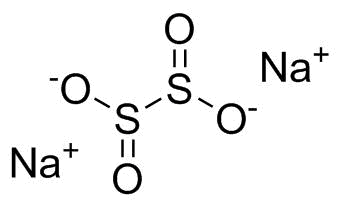 |
| Molecular Formula | Na2S2O4 |
| Molecular Weight | 174.10 |
| CAS Registry Number | 7775-14-6 |
| EC Number | 231-890-0 |
| SMILES | [O-]S(=O)S(=O)[O-].[Na+].[Na+] |
| Melting point | 300 °C (Expl.) |
|---|---|
| Solubility | water: 250 g/L (20 °C) (Expl.) |
| Hazard Symbols |   GHS02;GHS07 Danger Details GHS02;GHS07 Danger Details | ||||||||||||||||||||||||
|---|---|---|---|---|---|---|---|---|---|---|---|---|---|---|---|---|---|---|---|---|---|---|---|---|---|
| Risk Statements | H251-H302 Details | ||||||||||||||||||||||||
| Safety Statements | S26;S28A;S43E;S7/8 Details | ||||||||||||||||||||||||
| Hazard Classification | |||||||||||||||||||||||||
| |||||||||||||||||||||||||
| Transport Information | UN 1384 | ||||||||||||||||||||||||
| SDS | Available | ||||||||||||||||||||||||
 chemBlink Chemical Story
|
Sodium dithionite, CAS 7775-14-6, is a powerful inorganic reducing agent with the formula Na2S2O4. It is also widely known as sodium hydrosulfite, although "hydrosulfite" is an older name and should not be confused with bisulfite. Sodium dithionite is used in textile dyeing, pulp and paper processing, chemical synthesis, and other applications where a strong reducing environment is needed. One of its most interesting roles can be seen in an everyday object: blue jeans. The connection begins with indigo, one of humanity's oldest and most famous dyes. Indigo produces the deep blue associated with denim, but it has a troublesome property for a textile dye: ordinary indigo is essentially insoluble in water. That creates an obvious problem. Cotton consists largely of cellulose fibers containing microscopic pores and internal surfaces. A useful dyeing process must somehow bring dye into intimate contact with those fibers. If the blue pigment simply remains as insoluble particles suspended in water, it cannot penetrate and distribute through the fibers in the required way. Traditional indigo dyeing solved this problem long before chemists understood the molecular explanation. The dye was placed in a reducing alkaline vat, where the blue indigo was transformed into a different chemical form that could enter the textile. Modern industrial dyeing accomplishes the same fundamental transformation with carefully controlled reducing agents, and sodium dithionite became one of the most important. In alkaline solution, sodium dithionite reduces indigo to its leuco form. The transformation can be represented schematically as: Indigo + 2 e− + 2 H+ → leuco-indigo Under the alkaline conditions of a dye bath, the reduced form is present largely in ionized forms that are much more compatible with water than neutral indigo. Reduction therefore does something remarkable: it temporarily changes an insoluble blue pigment into a form that can be handled in an aqueous dyeing process. The color changes as well. The strongly colored conjugated electronic system responsible for indigo's familiar blue appearance is altered by reduction. The reduced dye bath therefore does not simply look like ordinary blue indigo dissolved in water. Cotton yarn or fabric is immersed in this reducing bath, allowing the soluble reduced dye to reach the fiber. Then comes the particularly elegant part of the process. The textile is removed from the vat and exposed to air. Oxygen now reverses what sodium dithionite accomplished. The reduced indigo is oxidized back to ordinary indigo: Leuco-indigo + O2 → indigo + oxidation products This equation is only schematic because the detailed oxidation chemistry depends on conditions, but the important transformation is clear. The soluble reduced form becomes the original insoluble blue pigment again. This time, however, the indigo is associated with the textile fibers. The fabric therefore develops its familiar blue color as it encounters oxygen. Indigo dyeing is unusual because the dye is deliberately made soluble only temporarily. Chemistry first removes the property that makes indigo useful as a durable pigment, allowing it to enter the textile, and then air restores that property after the dye is in place. Industrial denim dyeing commonly repeats dipping and oxidation several times. Each passage through the reducing bath introduces more reduced indigo, and each exposure to air produces another layer of blue pigment. Repetition allows the manufacturer to build the desired shade. This repeated reduction-oxidation cycle also helps explain some of denim's characteristic appearance. Indigo is concentrated substantially toward the outer regions of yarn rather than uniformly coloring every part of the fiber to the same depth. During wear and washing, pigment at exposed surfaces is gradually removed, revealing lighter material underneath. The famous fading patterns of blue jeans therefore depend not only on fashion and abrasion but also on how indigo was chemically deposited on the yarn. Sodium dithionite is particularly useful because it is a strong reducing agent capable of generating the low oxidation-reduction potential required to keep indigo in its reduced state during dyeing. But the same reactivity creates practical difficulties. Dithionite is readily oxidized by atmospheric oxygen. Its aqueous solutions are not indefinitely stable, and decomposition becomes more rapid under unfavorable conditions such as elevated temperature. Industrial dyeing therefore requires control of alkalinity, temperature, reducing-agent concentration, and exposure to air. This instability produces an interesting contradiction. Sodium dithionite is used precisely because it gives electrons away readily, but that also means oxygen can consume it before it performs the desired reaction. The reducing environment in an indigo vat must therefore be maintained rather than simply established once. Its industrial use also has environmental consequences. Oxidation and decomposition of dithionite ultimately generate sulfur-containing products such as sulfite and sulfate, contributing dissolved salts and sulfur compounds to textile wastewater. For this reason, considerable research has investigated alternative reducing systems for indigo dyeing, including reducing sugars, electrochemical processes, and other approaches intended to reduce dependence on sodium dithionite. The same reducing power explains applications outside textile dyeing. Sodium dithionite can reduce colored chemical structures and has consequently been used in bleaching processes, including pulp and paper treatment. Unlike oxidative bleaching agents, which destroy color by oxidation, dithionite provides reductive bleaching: colored chemical groups are transformed by gaining electrons. This distinction is chemically important. "Bleaching" does not describe one particular reaction. A substance can lose color because its chromophore has been oxidized, reduced, chemically cleaved, or otherwise altered. Sodium dithionite demonstrates the reductive route particularly well. Its behavior also demands careful handling. Solid sodium dithionite can decompose in contact with moisture and air, and decomposition can release heat. Under unsuitable storage conditions, self-heating can become a serious hazard. Acids can accelerate decomposition and lead to formation of sulfur dioxide. The material must therefore be protected from moisture, incompatible chemicals, and inappropriate storage conditions. Sodium dithionite is an excellent example of a chemical whose useful property and instability come from exactly the same source. It is valuable because it is eager to be oxidized. That eagerness allows it to reduce indigo, dyes, and other chemical species, but it also makes the reagent sensitive to oxygen and storage conditions. Its role in denim makes the chemistry particularly easy to visualize. Blue indigo begins as an insoluble pigment. Sodium dithionite supplies reducing power and temporarily converts it into a water-compatible form. Cotton enters the vat and takes up the reduced dye. The textile emerges into the air, oxygen takes over, and blue insoluble indigo appears again. The process seems almost backwards: to dye something blue with a blue pigment, chemists first make the pigment stop behaving like the blue pigment they want. Only after the dye reaches the fiber do they let oxygen turn it blue again. Every pair of traditionally indigo-dyed jeans is therefore a product of a carefully controlled chemical cycle: reduction makes the dye mobile, and oxidation makes the color stay. |
| Market Analysis Reports |