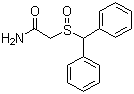
Modafinil is a wakefulness-promoting prescription drug with an unusual place in the chemistry of nervous-system medicines. Its structure has two phenyl rings joined through a common carbon, a sulfoxide group and a terminal acetamide. Those parts make a different molecular framework from drugs built around a phenethylamine skeleton. Yet a comparison of skeletons is only the start of a pharmacological comparison. It does not tell whether two drugs affect the same transporter, take the same route through the body or have the same clinical uses.
The sulfoxide makes modafinil a convenient example of stereochemistry at sulfur. The two carbon-containing groups attached to sulfur are different. The geometry of the sulfoxide permits two mirror-image arrangements, denoted R and S. Modafinil as supplied in Provigil is a racemate, containing both arrangements, whereas armodafinil denotes the R enantiomer. The distinction is more than a naming convention: the US prescribing information notes that the two enantiomers are eliminated at different rates. The proportion of each in the body after administration therefore need not remain the same as in the starting tablet. A registry entry for the racemate should not be silently replaced by one for an isolated enantiomer.
The United States first approved Provigil in 1998. The US label lists uses for improving wakefulness in adults with excessive sleepiness associated with narcolepsy, obstructive sleep apnea or shift work disorder. In obstructive sleep apnea the treatment addresses sleepiness rather than the physical obstruction. That wording distinguishes a measurable symptom from the cause of the disorder. The same label classifies modafinil as a Schedule IV controlled substance in the United States, a regulatory fact distinct from the chemistry that gives rise to its molecular structure.
Researchers have investigated what happens between administration and the resulting change in wakefulness. In 2009 Volkow and colleagues used positron emission tomography in a small study of healthy men. They measured signals from radiotracers sensitive to dopamine transporters and to changes in extracellular dopamine. The observations supported occupancy of dopamine transporters and increases in extracellular dopamine in several brain regions. These are observations in people under defined conditions, rather than extrapolations from a chemical drawing. At the same time, the scan cannot assign every aspect of the clinical response to a single molecular event. The approved label describes the mechanism by which modafinil promotes wakefulness as unknown.
A useful detail of the imaging study is that it used two different radiotracers. One was used to probe the availability of dopamine transporters. The other bound to dopamine receptors and was used as an indirect probe of changes in extracellular dopamine: endogenous dopamine and the tracer compete for receptor binding. The two readouts are complementary. A change in the first is evidence about access to a transporter, and a change in the second is interpreted in relation to signaling outside cells. Neither observation is the same as counting how many hours a participant felt alert. The methods make the inference more specific by defining what was measured and what still has to be inferred.
Modafinil thus gives three ways to identify what is being discussed: the material can be defined by stereochemistry, a human experiment can probe an effect on a signaling system, and a label can define the purposes for which the product has been evaluated and approved. Each describes a different scale of evidence. The differences between those scales are particularly useful when comparing modafinil with structurally related research compounds that have very different amounts of clinical documentation.
References:
1. DailyMed, Provigil (modafinil), US prescribing information. https://dailymed.nlm.nih.gov/dailymed/drugInfo.cfm?setid=0391f182-1958-9fef-a944-53b229ce99e7
2. Volkow ND et al. Effects of modafinil on dopamine and dopamine transporters in the male human brain. JAMA. 2009;301:1148–1154. https://pubmed.ncbi.nlm.nih.gov/19293415/
|






 GHS07;GHS08 Warning Details
 chemBlink Chemical Story