
Online Database of Chemicals from Around the World
| Shanghai Cosroma Biotech Co., LTD | China | |||
|---|---|---|---|---|
 | www.cosroma.com | |||
 | +86-21-31125890 | |||
 | +86-21-31125890 | |||
 | info@cosroma.com | |||
| Chemical manufacturer since 2017 | ||||
| chemBlink Standard supplier since 2021 | ||||
| Addtek Chemical | China | |||
|---|---|---|---|---|
| www.add-tek.com | |||
| +86 (21) 6335-2916 | |||
| info@add-tek.com | |||
| Chemical manufacturer since 2017 | ||||
| chemBlink Standard supplier since 2021 | ||||
| Guangzhou Jun Xin Chemical Technology Co., Ltd. | China | |||
|---|---|---|---|---|
| www.jxinchem.com | |||
| +86 (020) 8256-9208 | |||
| +86 (020) 2826-9100 | |||
| ivyyoung@gzjxchem.com | |||
 | QQ Chat | |||
 | WeChat: gzjx18122041046 | |||
 | WhatsApp:+8618122041046 | |||
| Chemical distributor since 2007 | ||||
| chemBlink Standard supplier since 2026 | ||||
| Classification | Chemical reagent >> Organic reagent >> Amide |
|---|---|
| Name | Cocamidopropylamine Oxide |
| Molecular Structure | 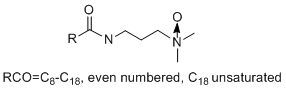 |
| CAS Registry Number | 68155-09-9 |
| EC Number | 268-938-5 |
| Hazard Classification | |||||||||||||||||||||||||||||||||||||||||
|---|---|---|---|---|---|---|---|---|---|---|---|---|---|---|---|---|---|---|---|---|---|---|---|---|---|---|---|---|---|---|---|---|---|---|---|---|---|---|---|---|---|
| |||||||||||||||||||||||||||||||||||||||||
 Discovery and Applications
|
Cocamidopropylamine oxide is a nonionic to zwitterionic surfactant widely used in personal care and household cleaning products, particularly shampoos, body washes, and liquid detergents. It is derived from coconut fatty acids and belongs to the class of amine oxide surfactants, which are known for their good foaming properties, mildness, and compatibility with other surfactants. The molecular structure of cocamidopropylamine oxide is based on a fatty alkyl chain, typically a C12–C18 mixture derived from coconut oil, linked through a propyl spacer to an amine oxide functional group. The amine oxide head group consists of a tertiary amine oxidized to form an N→O bond, giving the nitrogen a formal positive charge and the oxygen a partial negative character. This internal charge separation gives amine oxides a zwitterionic or highly polar character depending on pH. The compound is typically produced in two main steps. First, fatty acids from coconut oil are converted into cocamidopropylamine through amidation and reaction with 3-dimethylaminopropylamine or related intermediates. In the second step, the tertiary amine is oxidized using hydrogen peroxide to form the corresponding amine oxide. This oxidation step is carefully controlled to avoid over-oxidation or degradation of the fatty chain. Cocamidopropylamine oxide functions as a surfactant due to its amphiphilic structure. The long hydrophobic alkyl chain interacts with oils and nonpolar substances, while the polar amine oxide group interacts strongly with water through hydrogen bonding and electrostatic interactions. This dual nature allows it to reduce surface tension and form micelles in aqueous solution. In formulation systems, cocamidopropylamine oxide is valued for its ability to enhance foam volume and stability, especially when used in combination with anionic surfactants such as sodium lauryl sulfate or ammonium lauryl ether sulfate. It can also act as a foam booster and viscosity modifier, improving the texture and sensory properties of cleansing products. Compared with some purely anionic surfactants, amine oxides like cocamidopropylamine oxide are generally considered milder to skin and mucous membranes. This is due to their nonionic or amphoteric behavior, which reduces strong interactions with skin proteins. As a result, they are frequently used in formulations designed for daily use and sensitive skin applications. The behavior of cocamidopropylamine oxide is pH-dependent. In acidic conditions, the amine oxide group remains protonated and highly polar, while in neutral to slightly alkaline conditions it behaves as a stable zwitterionic surfactant. This flexibility contributes to its broad compatibility with different formulation environments. In aqueous systems, cocamidopropylamine oxide forms micelles above its critical micelle concentration, enabling emulsification and solubilization of oils, fragrances, and dirt particles. It also improves wetting of surfaces, making it useful in both personal care and industrial cleaning applications. Beyond personal care, cocamidopropylamine oxide is used in household detergents, dishwashing liquids, and industrial cleaners. Its good compatibility with other surfactant classes allows it to be incorporated into complex formulations where foam control, cleaning efficiency, and mildness must be balanced. Overall, cocamidopropylamine oxide is a coconut-derived amine oxide surfactant characterized by a long hydrophobic fatty chain and a polar N-oxide head group. Its amphiphilic structure provides effective foaming, emulsifying, and cleaning properties, making it a widely used ingredient in modern cleansing and detergent formulations. References none |
| Market Analysis Reports |