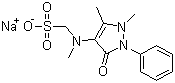
A drug's chemical story does not end with the structure printed on its label. Dipyrone, also called metamizole or Analgin, illustrates the importance of following a compound through its transformations. CAS 68-89-3 identifies the anhydrous sodium salt, whereas CAS 5907-38-0 describes the corresponding monohydrate. The two entries differ in solid composition while remaining closely connected to the same medicinal substance.
Metamizole is a non-opioid analgesic and antipyretic associated with the pyrazolone family. Its sodium sulfonate-containing structure is distinct from the active transformation products subsequently investigated in biological samples. The compound acts as a prodrug, making conversion an essential part of the explanation rather than an unwanted complication that can simply be ignored.
Among the important products is 4-methylaminoantipyrine, often abbreviated 4-MAA. Further metabolism generates additional compounds, including 4-aminoantipyrine. The concentrations and time courses of these species need not be identical. Consequently, a study that quantifies a metabolite is answering a more specific question than simply asking whether the original medicine was present.
Research into this metabolic network has used both laboratory systems and controlled human studies. A study published in the British Journal of Clinical Pharmacology identified CYP1A2 as an important enzyme in the hepatic metabolism of 4-MAA. The work examined enzyme contributions and changes in metabolite exposure under the tested conditions. It shows why understanding a prodrug includes investigating the subsequent fate of its products, not only the initial conversion.
This distinction has analytical consequences. Measuring unchanged metamizole in a formulation, measuring 4-MAA in plasma, and comparing exposure to several metabolites require different methods and reference materials. A common drug name links the investigations, but it does not make their measured quantities interchangeable. Time, sample type, and chemical identity remain part of the result.
The medicine also has a continuing safety history. The European Medicines Agency's 2024 review strengthened measures concerning agranulocytosis, a potentially serious loss of granulocytes. The review emphasizes that past use without problems does not eliminate this risk. Scientific discussion of established pain- and fever-relieving applications therefore needs to retain the distinction between therapeutic activity and an acceptable benefit-risk assessment for a particular authorized use.
Neither its long history nor the identification of active metabolites provides a simple universal statement about safety. Likewise, differences between the anhydrous and hydrated solids should not be presented as if they created two unrelated pharmacological agents. Solid-state identity helps define the supplied material, while metabolism helps explain the chemical species encountered after administration.
A prodrug also poses a useful question about what a pharmacokinetic curve represents. The horizontal axis follows time, but the vertical axis refers to a particular measured substance. Two curves may both be associated with the same administered medicine while describing different molecules. Their peaks and decline cannot be assumed to coincide merely because they share a common starting point in a metabolic pathway.
This is why enzyme studies and analytical validation complement one another. A validated assay establishes that a specified analyte can be measured in the chosen sample. A metabolic experiment investigates how that analyte is formed or removed under defined conditions. Together, the approaches help distinguish a change in chemical exposure from a change in the measurement itself. They also show why an overall drug name is often too broad to communicate the most informative result.
Dipyrone consequently connects several levels of chemistry: a specified sodium salt, solution transformation, enzyme-mediated metabolism, and the analysis of distinct products. Following those levels separately makes the story more informative. The original molecule is an entry point into a changing chemical system, and understanding that system requires evidence about both useful effects and important adverse outcomes.
References:
1. PubChem. Metamizole sodium, CAS 68-89-3; CID 522325. https://pubchem.ncbi.nlm.nih.gov/compound/522325
2. Cytochrome P450 1A2 is the most important enzyme for hepatic metabolism of the metamizole metabolite 4-methylaminoantipyrine. Br J Clin Pharmacol. https://pubmed.ncbi.nlm.nih.gov/34648192/
3. European Medicines Agency. Metamizole-containing medicinal products: 2024 review and measures concerning agranulocytosis. https://www.ema.europa.eu/en/medicines/human/referrals/metamizole-containing-medicinal-products-0
|








 GHS07;GHS08;GHS09 Danger Details
 chemBlink Chemical Story