Online Database of Chemicals from Around the World

Broxuridine
[CAS 59-14-3]

List of Suppliers
Hangzhou Verychem Science And Technology Co., Ltd. China
www.verychem.com
+86 (571) 8816-2785
+86 13606544505
+86 (571) 8816-2787
lucy@verychem.com
Chemical manufacturer since 2004
chemBlink Massive supplier since 2021
Shanghai Oripharm Co., Ltd. China
www.oripharm.com.cn
+86 (21) 6439-6936
+86 (21) 6481-4386
info@oripharm.com.cn
sales@oripharm.com.cn
Chemical distributor since 2003
chemBlink Standard supplier since 2006
Nanjing Search Biotech Co., Ltd. China
www.searchbio.com.cn
+86 (25) 8168-2922
8586-0978
+86 18913919581
+86 (25) 8586-0962
trade@searchbio.com.cn
sales@searchbio.com.cn
Linda@searchbio.com.cn
QQ Chat
Chemical manufacturer since 2007
chemBlink Standard supplier since 2007
Simagchem Corporation China
www.simagchem.com
+86 13806087780
+86 (592) 268-0237
sale@simagchem.com
Chemical manufacturer since 2002
chemBlink Standard supplier since 2008
Wilshire Technologies, Inc. USA
www.wilshiretechnologies.com
+1 (609) 683-1117
+1 (732) 274-0049
Wilshire-info@evonik.com
Chemical manufacturer since 1997
chemBlink Standard supplier since 2010
AAT Bioquest, Inc. USA
www.aatbio.com
+1 (408) 733-1055
+1 (408) 733-1304
jack@aatbio.com
Chemical manufacturer since 2005
chemBlink Standard supplier since 2010
BOC Sciences USA
www.bocsci.com
+1 (631) 485-4226
+1 (631) 614-7828
info@bocsci.com
Chemical manufacturer
chemBlink Standard supplier since 2010
NetQem, LLC USA
www.netqem.us
+1 (919) 544-4122
+1 (919) 544-4109
sales@netqem.us
Chemical distributor since 2013
chemBlink Standard supplier since 2014
Hangzhou Leap Chem Co., Ltd. China
www.leapchem.com
+86 (571) 8771-1850
market19@leapchem.com
QQ Chat
Chemical manufacturer since 2006
chemBlink Standard supplier since 2015
Amadis Chemical Co., Ltd. China
www.amadischem.com
+86 (571) 8992-5085
+86 (571) 8992-5065
sales@amadischem.com
Chemical manufacturer since 2010
chemBlink Standard supplier since 2015
AAA Biotech USA
www.aaabiotech.com
+1 (619) 604-9440
cynthia@aaabiotech.com
Chemical manufacturer since 2021
chemBlink Standard supplier since 2026
LKT Laboratories, Inc. USA
www.lktlabs.com
+1 (888) 558-5227
+1 (651) 644-8357
peacerli@mbolin-lktlabs.com
Chemical manufacturer
GLSynthesis Inc. USA
www.glsynthesis.com
+1 (508) 754-6700
+1 (508) 754-7075
support@glsynthesis.com
Chemical manufacturer
Chemos GmbH & Co. KG Germany
www.chemos.de
+49 871-966346-0
+49 871-966346-13
chemos@chemos.de
Chemical distributor
Berry & Associates, Inc. USA
www.berryassoc.com
+1 (734) 426-3787
+1 (734) 426-9077
orders@berryassoc.com
Chemical manufacturer
Toronto Research Chemicals Inc. Canada
www.trc-canada.com
+1 (416) 665-9696
+1 (416) 665-4439
info@trc-canada.com
Chemical manufacturer since 1982
Apollo Scientific Ltd. UK
www.apolloscientific.co.uk
+44 (161) 406-0505
+44 (161) 406-0506
sales@apolloscientific.co.uk
Chemical manufacturer
Indofine Chemical Company, Inc. USA
www.indofinechemical.com
+1 (888) 463-6346
+1 (908) 359-1179
info@indofinechemical.com
Chemical manufacturer since 1981

Identification
ClassificationBiochemical >> Nucleoside drugs >> Deoxynucleotides and their analogues
NameBroxuridine
Synonyms5-Bromo-2'-deoxyuridine; 2'-Deoxy-5-bromouridine; BDU
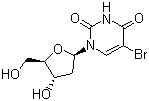
Molecular StructureBroxuridine molecular structure (CAS 59-14-3)
Molecular FormulaC9H11BrN2O5
Molecular Weight307.10
CAS Registry Number59-14-3
EC Number200-415-9
SMILESC1[C@@H]([C@H](O[C@H]1N2C=C(C(=O)NC2=O)Br)CO)O
Properties
Density1.9±0.1 g/cm3 Calc.*
Melting point191 - 194 °C (Decomposes) (Expl.)
SolubilityDMSO: 50 mg/mL, water: 50 mM (Expl.)
Index of refraction1.652 (Calc.)*
*Calculated using Advanced Chemistry Development (ACD/Labs) Software.
Safety Data
Hazard Symbolssymbol   GHS08 Danger  Details
Risk StatementsH340-H341-H361  Details
Safety StatementsP203-P280-P318-P405-P501  Details
Hazard Classification
up    Details
HazardClassCategory CodeHazard Statement
Reproductive toxicityRepr.2H361
Germ cell mutagenicityMuta.1BH340
Germ cell mutagenicityMuta.2H341
CarcinogenicityCarc.2H351
Germ cell mutagenicityMuta.1AH340
Skin irritationSkin Irrit.2H315
Eye irritationEye Irrit.2H319
Reproductive toxicityRepr.2H361fd
Specific target organ toxicity - single exposureSTOT SE3H335
Reproductive toxicityRepr.1AH360
SDSAvailable
up chemBlink Chemical Story
Broxuridine is better known in laboratories as bromodeoxyuridine, or BrdU. It resembles the DNA building block thymidine, but the methyl group on the base is replaced by bromine. The sugar is still deoxyribose. Thus the compound is a nucleoside, not simply bromouracil, and not a nucleotide carrying phosphate. These distinctions explain why the material added to a cell and the form ultimately used during DNA synthesis are not identical.

Cells can convert the nucleoside to phosphorylated derivatives. The triphosphate can be used during DNA synthesis in place of the usual thymidine-derived nucleotide. The resulting DNA bears a chemical mark indicating incorporation during the period the label was available. The bromine is part of the base itself; it is not a dye that lights up independently. To see where the analogue went, a separate detection method is needed.

A 1982 study by Gratzner described a monoclonal antibody that recognized brominated and iodinated deoxyuridine labels. The approach helped make replication visible by antibody staining and quantifiable by flow cytometry. It enabled a change in the experimental question: rather than simply determining that a population synthesized DNA, investigators could examine which cells carried the label. The antibody's recognition also illustrates why access matters. A label incorporated inside double-stranded DNA is not necessarily accessible to an antibody under the same conditions as a label on an exposed strand.

The original antibody recognized more than one halogenated analogue. That is a reminder that the name of a reagent is not a complete description of its selectivity. When two labels are intended to distinguish different periods of synthesis, recognition of both by the same antibody would not identify which period produced a signal. The detection chemistry needs to be considered alongside the choice of label. An experiment with unlabelled controls can help separate signal due to the incorporated analogue from background attributable to the sample or detection system.

A later method highlighted another practical issue with antibody recognition. In 2008, Salic and Mitchison reported a method using ethynyl deoxyuridine, or EdU, which has a different substituent on the base. They detected the incorporated analogue by forming a chemical bond with a fluorescent reagent rather than by antibody recognition of a brominated base. Their comparison pointed out that BrdU detection commonly requires exposing the label by disrupting the DNA duplex. The competing approaches therefore differ not only in the marker incorporated but also in how a record is read and what other features of the sample can be preserved.

That history clarifies a distinction useful beyond this particular analogue. Incorporation, detection, and interpretation are separate steps. A compound can be accepted by the cellular machinery yet be difficult to detect. A bright signal can be detected reliably yet correspond to a different process from the one the researcher intended to count.

A positive signal indicates DNA synthesis under the experimental conditions, not automatically a complete cell division. DNA repair can also entail synthesis, and cells that incorporate the label may not all proceed to mitosis. Conversely, a cell outside the period of observation can divide later and be missed. The timing of labeling and the biological context therefore matter to the interpretation. Incorporating an analogue can itself influence cells, so the marker is not a chemically invisible observer. Broxuridine remains an instructive example of using a close structural resemblance to record a biological event while using a distinct chemical feature to detect the record.

References:
1. PubChem. 5-Bromo-2'-deoxyuridine, CID 6035. https://pubchem.ncbi.nlm.nih.gov/compound/6035
2. Gratzner HG. Monoclonal antibody to 5-bromo- and 5-iododeoxyuridine. Science (1982). https://pubmed.ncbi.nlm.nih.gov/7123245/
3. Salic A and Mitchison TJ. Chemical detection of DNA synthesis with EdU. PNAS (2008). https://doi.org/10.1073/pnas.0712168105

Market Analysis Reports
Related Products
Broussonin C  Broussonin E  Brovanexine  Brovincamine  Brovincamine Fu...  Brown 1  Browniine  Broxaldine  Broxaterol  Broxitalamic Ac...  Bruceanic Acid ...  Bruceanic Acid ...  Bruceanol A  Bruceanol B  Bruceanol C  Bruceanol D  Bruceanol E  Bruceanol G  Bruceanol H  Bruceantarin