
Online Database of Chemicals from Around the World
| Ningbo Hi-Tech Biochemicals Co., Ltd. | China | |||
|---|---|---|---|---|
 | www.hi-techbiochem.com | |||
 | +86 (574) 2786-5813 | |||
 | +86 (574) 2771-1846 | |||
 | info@hi-techbiochem.com peng.shifeng@hi-techbiochem.com | |||
| Chemical manufacturer since 2006 | ||||
| chemBlink Standard supplier since 2010 | ||||
| BOC Sciences | USA | |||
|---|---|---|---|---|
| www.bocsci.com | |||
| +1 (631) 485-4226 | |||
| +1 (631) 614-7828 | |||
| info@bocsci.com | |||
| Chemical manufacturer | ||||
| chemBlink Standard supplier since 2010 | ||||
| Zhejiang Boxiao Biopharmaceutical Co., Ltd. | China | |||
|---|---|---|---|---|
| www.bx-biopharm.com | |||
| +86 (571) 6328-0982 | |||
| helena_huang@bx-biopharm.com | |||
 | QQ Chat | |||
| Chemical manufacturer since 2020 | ||||
| chemBlink Standard supplier since 2023 | ||||
| Classification | API >> Anesthetic agents >> Local anesthetics |
|---|---|
| Name | Chloroprocaine hydrochloride |
| Synonyms | 2-Diethylaminoethyl 4-amino-2-chlorobenzoate hydrochloride |
| Molecular Structure | 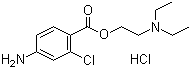 |
| Molecular Formula | C13H19ClN2O2.HCl |
| Molecular Weight | 307.22 |
| CAS Registry Number | 3858-89-7 |
| EC Number | 223-371-2 |
| SMILES | CCN(CC)CCOC(=O)C1=C(C=C(C=C1)N)Cl.Cl |
| Melting point | 176 °C (Expl.) |
|---|---|
| Hazard Symbols |  GHS06 Warning Details GHS06 Warning Details | ||||||||
|---|---|---|---|---|---|---|---|---|---|
| Risk Statements | H301 Details | ||||||||
| Safety Statements | P264-P270-P301+P316-P321-P330-P405-P501 Details | ||||||||
| Hazard Classification | |||||||||
| |||||||||
| SDS | Available | ||||||||
 chemBlink Chemical Story
|
Chloroprocaine hydrochloride is the hydrochloride salt of 2-chloroprocaine, an ester local anesthetic introduced in the early 1950s. Foldes and McNall published the early clinical description in 1952 as '2-Chloroprocaine: a new local anesthetic agent.' Chemically it is a chlorinated derivative of procaine. Like other local anesthetics, chloroprocaine blocks voltage-gated sodium-channel-dependent nerve impulse conduction and produces reversible loss of sensation. Its distinguishing feature is rapid hydrolysis by plasma pseudocholinesterase, contributing to short duration and relatively rapid recovery. This profile supports selected regional and spinal anesthesia uses where a brief block is advantageous. The exact registry identity matters because related free forms, salts, hydrates, stereoisomers, process intermediates and finished medicines can have separate CAS numbers even when their names share a familiar stem. In pharmaceutical and fine-chemical work this distinction is practical: composition changes formula weight and can alter solubility, crystallization, analytical standards, manufacturing specifications and interpretation of physical-property data. The molecule also illustrates how chemists use functional groups as deliberate handles. Aromatic rings and heterocycles establish shape and electronic character, while amines, alcohols, carbonyl groups, carboxylic acids, esters or ionic centers control reactivity and intermolecular interactions. In a multistep route, an intermediate may be valuable precisely because one group can be transformed selectively while another survives for a later operation. Modern development is equally an analytical problem. Chemists must demonstrate identity and purity, control stereochemistry or salt composition where relevant, follow process-related impurities and establish reproducible specifications. Reference materials and isolated intermediates therefore have scientific importance even when they are never administered to a patient or sold as the final commercial product. A careful Chemical Story must distinguish documented use from structural possibility. A familiar scaffold can suggest a biological hypothesis, but resemblance is not evidence that the exact CAS substance has been tested, approved or commercially adopted for that purpose. The account therefore emphasizes verified identity, development history and supported applications, and deliberately leaves unsupported claims out. Seen more broadly, the compound shows that useful molecular design rarely depends on one functional group in isolation. Performance emerges from the whole structure, stereochemistry and physical form, the route used to make it, and the environment in which it operates. Connecting those molecular details to a real manufacturing, analytical or therapeutic role turns a technical registry entry into a meaningful chemical story. The exact registry identity matters because related free forms, salts, hydrates, stereoisomers, process intermediates and finished medicines can have separate CAS numbers even when their names share a familiar stem. In pharmaceutical and fine-chemical work this distinction is practical: composition changes formula weight and can alter solubility, crystallization, analytical standards, manufacturing specifications and interpretation of physical-property data. The molecule also illustrates how chemists use functional groups as deliberate handles. Aromatic rings and heterocycles establish shape and electronic character, while amines, alcohols, carbonyl groups, carboxylic acids, esters or ionic centers control reactivity and intermolecular interactions. In a multistep route, an intermediate may be valuable precisely because one group can be transformed selectively while another survives for a later operation. Modern development is equally an analytical problem. Chemists must demonstrate identity and purity, control stereochemistry or salt composition where relevant, follow process-related impurities and establish reproducible specifications. Reference materials and isolated intermediates therefore have scientific importance even when they are never administered to a patient or sold as the final commercial product. References: 1. Foldes FF, McNall PG. Anesthesiology. 1952;13:287-296. 2. PubChem. Chloroprocaine Hydrochloride. 3. USP-NF. Chloroprocaine Hydrochloride monograph. |
| Market Analysis Reports |