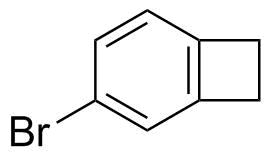
4-Bromobenzocyclobutene is a halogen-substituted derivative of benzocyclobutene, consisting of a benzene ring fused to a strained four-membered cyclobutene ring with a bromine atom attached to the aromatic ring. The molecular formula reflects a bicyclic aromatic–olefinic system containing one bromine substituent, which introduces a reactive carbon–bromine bond suitable for further functionalization.
The benzocyclobutene core is a well-studied strained bicyclic structure in organic chemistry. It is composed of a benzene ring fused to a cyclobutene ring, where the cyclobutene unit is significantly strained due to deviation from ideal bond angles. This strain is a key feature of benzocyclobutene chemistry, as it enables thermal ring opening reactions that generate highly reactive o-quinodimethane intermediates. These intermediates can undergo cycloaddition reactions and polymerization processes, making benzocyclobutene derivatives valuable in synthetic and materials chemistry.
In 4-bromobenzocyclobutene, the presence of a bromine substituent on the aromatic ring introduces a functional handle for cross-coupling reactions. The carbon–bromine bond is polarized and can undergo substitution or catalytic transformations, particularly in palladium-catalyzed reactions such as Suzuki, Heck, or Sonogashira couplings. This allows the compound to serve as a versatile intermediate for constructing more complex aromatic or polymerizable structures.
The chemistry of benzocyclobutene derivatives has been studied extensively since the mid-20th century, particularly in the context of thermal rearrangements and polymer science. Researchers discovered that upon heating, the cyclobutene ring undergoes reversible electrocyclic ring opening to form o-quinodimethane species. These reactive intermediates can participate in Diels–Alder reactions or polymer crosslinking, enabling the design of thermally curable resins. Substituted benzocyclobutene compounds, including halogenated variants like 4-bromobenzocyclobutene, were developed to tune reactivity and enable further chemical modification.
Synthesis of 4-bromobenzocyclobutene typically involves construction of the benzocyclobutene framework followed by selective bromination of the aromatic ring. The cyclobutene ring is generally formed through intramolecular cyclization strategies starting from ortho-allyl or ortho-vinyl aromatic precursors, followed by controlled ring closure under thermal or photochemical conditions. Electrophilic bromination is then used to introduce the bromine substituent at the desired position, often under conditions that preserve the strained bicyclic system.
In terms of applications, 4-bromobenzocyclobutene is primarily used as an intermediate in organic synthesis and materials chemistry. Its bromine substituent allows it to participate in cross-coupling reactions to introduce diverse functional groups, while the benzocyclobutene core provides latent reactivity through thermally induced ring opening. This dual functionality makes it useful in the design of advanced polymers, particularly those used in microelectronics and high-performance materials.
Benzocyclobutene-based monomers and derivatives have been explored in the development of low-dielectric constant materials for semiconductor applications. Upon thermal activation, these materials can form crosslinked networks without the release of volatile byproducts, which is advantageous for microelectronic fabrication. Halogenated derivatives such as 4-bromobenzocyclobutene provide additional synthetic flexibility for incorporating the benzocyclobutene unit into larger molecular architectures.
Overall, 4-bromobenzocyclobutene is a functionalized strained bicyclic aromatic compound that combines the unique thermal reactivity of the benzocyclobutene system with the synthetic versatility of an aromatic bromide. Its discovery and use are closely tied to the development of reactive monomers and thermally curable materials, and it continues to serve as a useful intermediate in organic synthesis and advanced materials research.
References
2022. Recent Progress on Transition-Metal-Mediated Reductive C(sp3)–O Bond Radical Addition and Coupling Reactions. Synthesis.
DOI: 10.1055/a-1848-3005
2013. Synthesis of a Polymerizable Benzocyclobutene that Undergoes Ring-Opening Isomerization at Reduced Temperature. Synlett.
DOI: 10.1055/s-0033-1339925
|





 GHS07 Warning Details
 chemBlink Chemical Story