
Online Database of Chemicals from Around the World
| Dancheng Huatai Biological Technology Co., Ltd. | China | |||
|---|---|---|---|---|
 | www.htbioth.com | |||
 | +86 13482210809 | |||
 | hli@3wpharm.com | |||
 | QQ Chat | |||
 | WeChat: 13482210809 | |||
 | WhatsApp:13482210809 | |||
| Chemical manufacturer since 2021 | ||||
| chemBlink Standard supplier since 2023 | ||||
| Nonsensia | Poland | |||
|---|---|---|---|---|
| nonsensia.pl | |||
| +48 506 848 838 | |||
| nonsensia@outlook.com | |||
| Chemical manufacturer since 2023 | ||||
| chemBlink Standard supplier since 2026 | ||||
| Classification | Organic raw materials >> Ketone compound |
|---|---|
| Name | Mebicar |
| Synonyms | 1,3,4,6-tetramethyl-3a,6a-dihydroimidazo[4,5-d]imidazole-2,5-dione |
| Molecular Structure | 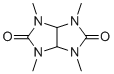 |
| Molecular Formula | C8H14N4O2 |
| Molecular Weight | 198.22 |
| CAS Registry Number | 10095-06-4 |
| EC Number | 682-123-5 |
| SMILES | CN1C2C(N(C1=O)C)N(C(=O)N2C)C |
| Solubility | 2.652e+005 mg/L (25 °C water) |
|---|---|
| Density | 1.2±0.1 g/cm3, Calc.* |
| Index of Refraction | 1.535, Calc.* |
| Melting point | 120.78 °C |
| Boiling Point | 339.91 °C, 362.2±42.0 °C (760 mmHg), Calc.* |
| Flash Point | 171.9±20.2 °C, Calc.* |
| * | Calculated using Advanced Chemistry Development (ACD/Labs) Software. |
| Hazard Symbols |  GHS07 Warning Details |
|---|---|
| Risk Statements | H302 Details |
| Safety Statements | P264-P270-P301+P317-P330-P501 Details |
| SDS | Available |
 chemBlink Chemical Story
|
Mebicar is the drug name for tetramethylglycoluril, a compound whose systematic name makes it sound more elaborate than its structure actually is. At its center are two five-membered rings sharing a carbon–carbon bond. Each ring contains a carbonyl flanked by two nitrogen atoms, and each of the four nitrogens carries a methyl group. The structure thus packs two urea-like units into a small fused framework. The methyl groups are attached directly to nitrogen; the name should not be confused with tetramethylolglycoluril, in which hydroxymethyl groups are attached instead. These structural details change how the molecule can interact with its surroundings. Methylating the nitrogen atoms removes the N–H bonds that would otherwise supply hydrogen-bond donors. The carbonyl oxygens remain potential acceptors. Meanwhile, the atoms that connect the two rings constrain their relative positions. A drawing of mebicar therefore gives a useful picture of why counting nitrogen atoms alone tells little about a molecule's behavior: the positions of those atoms, the bonds around them and what they are attached to all matter. The structural observation does not identify a pharmacological target. Adaptol is the name under which mebicar appears in regional clinical literature. A 2010 publication examined emotional burnout using clinical and neurophysiological observations. Another report evaluated treatment in people described as having neurocirculatory asthenia, combining clinical and psychological assessments. The latter diagnostic term belongs to a particular clinical tradition; it cannot simply be mapped onto every modern category of anxiety or stress-related illness. These papers document the kinds of questions investigators asked. They do not by themselves give a broadly generalizable estimate of effectiveness or establish a molecular mechanism. The two names also illustrate a practical problem in reviewing evidence. A chemistry database may index the compound by its ring system, while a medical abstract uses only a brand name and a transliterated diagnosis. Searching by the registry number and checking the structure can connect those records without assuming that every similarly named compound is the same substance. References: 1. PubChem, Mebicar (CID 122282). https://pubchem.ncbi.nlm.nih.gov/compound/122282 2. Clinical and neurophysiological study of Adaptol in emotional burnout (2010). https://pubmed.ncbi.nlm.nih.gov/21183911/ 3. Neurocirculatory asthenia: psychoautonomic features and treatment possibilities (2012). https://pubmed.ncbi.nlm.nih.gov/23388593/ |
| Market Analysis Reports |